Machine Learning in Arrhythmia
Published:
Being in a computational cardiology lab, machine learning and arrhythmia are two of most common keywords we discuss in meetings. Machine Learning and Arrhythmia: Advances in Atrial Fibrillation Detection and Management by Yazdi et al. (2025) reviews recent advancements in the diagnosis and management of atrial fibrillation through machine learning 1.
What we know (and don’t know) about AF detection and management
Atrial fibrillation is the most common sustained cardiac arrythmia and is associated with many comorbidities such as age, heart failure, valvular disease, and more. In the US, life-time risk of AF is 1 in 3 for white individuals and 1 in 5 for black individuals. While early management of AF can reduce incidence of stroke, heart failure, and recurrence, clinical presentation of AF can be heterogenous. Some patients suffer from symptoms like dyspnea and chest pain, yet a large population are also asymptomatic. Therefore, with this inherent heterogeneity, it is challenging to predict the risk of AF.
How can machine learning help?
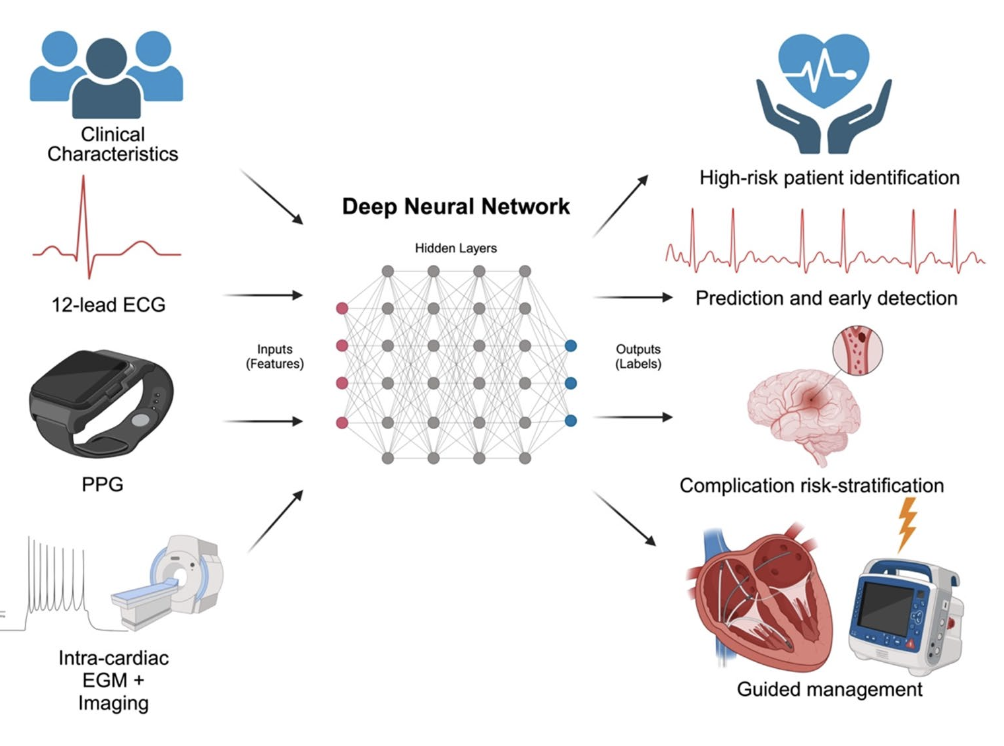 Traditional predictive scores for new-onset AF are based on clinical characteristics. For example, CHARGE-AF is a 5-year score for incident AF prediction using prominent comorbidities. Although the risk calculator has demonstrated some level of accuracy, it is not very generalizable since it was primarily developed and validated using elderly, European cohorts.
Machine learning architectures can leverage its ability to self-define the relationship between inputs (clinical features) and their corresponding outputs (labels) after training. One prominent example includes Deep Neural Networks (DNNs), which can learn complex, hierarchical relationships in heterogenous datasets through backpropagation. These AI systems are constantly researched to become more explainable to identify the most important datapoints that drive the prediction.
Current methodologies are shifting away from single-modality inputs toward multimodal fusion, integrating electrocardiograms (ECG), medical imaging (MRI, CT, ECHO etc.), and electronic health records (EHR). This holistic approach leverages the unique predictive value of each domain to enhance model robustness and generalizability.
Current challenges in machine learning
While ML has shown promise in diagnosis and management of AF, ML algorithms inherently suffer from being a black or grey box model that does not provide enough explanation behind its decision making. A lot of modern DL systems also require a large, representative diverse dataset to train and validate its predictions. It is difficult for clinical cohorts to satisfy this requirement, since there exists many legal and ethical barriers to obtain cross-institution data, such as patient data transfer policies and de-identification issues. Moreover, clinical data are real-life data derived from unique individuals and therefore inevitably contain noises.
Thoughts
While these challenges do pose difficulties to develop accurate and useful medical AI systems, I believe they are also what also continuously push the direction of healthcare AI development to be more interpretable and generalizable.
This trajectory of the work aligns with what I hope to do in my PhD research. By examining the multifaceted nature of cardiovascular diseases, I hope to address the “black box” challenge by identifying specific anatomical or clinical features that drive the risk. Fortunately, cardiology is a relatively well-studied field in medicine due to its prominence in our lives, and its (relative) richness in data helps greatly with the investigation. I hope to leverage this advantage in cardiology to advance the field of deep learning in cardiovascular disease prediction.
Yazdi V, Kadiyala V, Chugh SS. Machine Learning and Arrhythmia: Advances in Atrial Fibrillation Detection and Management. Curr Atheroscler Rep. 2025 Nov 28;27(1):119. doi: 10.1007/s11883-025-01366-z. PMID: 41313514; PMCID: PMC12662886. ↩


