PRISM2: Learning Pathology through Clinical Dialogue
Published:
End-to-end multimodal pathology foundation model with clinical dialogue by Vorontsov et al. (2026) introduces PRISM2 1. The headline result is impressive: without task-specific training, one generalist model matched or exceeded three specialized clinical-grade systems for detecting invasive cancer in prostate, breast, and breast lymph-node specimens. However, the part I found more interesting is how the authors trained the model. Rather than treating pathology reports as captions, PRISM2 converts them into clinical questions and answers so that the model learns to connect histology with the concepts a pathologist actually reasons about.
The paper brings together several themes that interest me: multimodal representation learning, weak supervision from routinely collected clinical data, transfer learning, calibration, and the gap between benchmark performance and real clinical generalizability.
Why tile-level pathology models are not enough
A whole-slide image (WSI) is a gigapixel image. It is too large to pass directly through a conventional neural network, so most computational pathology pipelines divide the slide into thousands of small tiles. A pretrained image encoder can represent each tile, but a clinically useful prediction is usually made for a specimen or patient rather than for one isolated patch.
This creates an aggregation problem. A task-specific model must learn which tiles matter and how findings across multiple slides fit together. Training a new aggregator for every outcome requires labels and can overfit, especially for rare cancers or small clinical cohorts. PRISM2 instead aims to learn a reusable slide-level representation before the downstream task is defined.
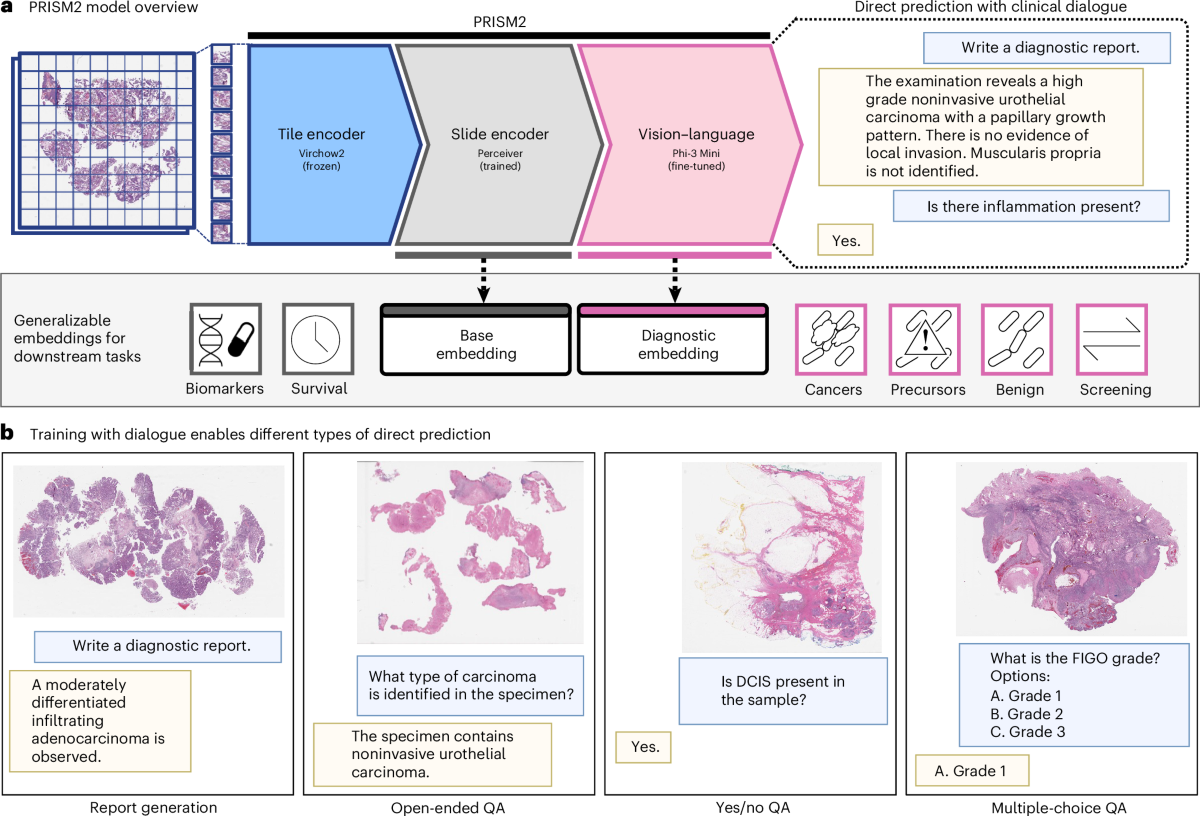
The pipeline has three main components:
- A frozen Virchow2 tile encoder converts every 224-by-224-pixel tissue tile into an embedding.
- A trainable Perceiver slide encoder compresses as many as 100,000 tile embeddings from one specimen into 256 latent vectors and a compact base embedding.
- A Phi-3 Mini vision-language model receives the slide latents and a text prompt. It produces an answer as well as a diagnosis-focused representation.
Although the paper calls PRISM2 multimodal, the clinical modality available at inference is still the H&E slide; language provides the prompt and the supervisory structure learned during pretraining. The important multimodal alignment is therefore between tissue morphology and diagnostic language.
Turning routine reports into 14 million conversations
PRISM2 was trained using 685,507 specimens from 200,692 patients, corresponding to 2,350,518 WSIs and the same number of paired clinical reports as specimens. The reports and all slides were processed at Memorial Sloan Kettering Cancer Center (MSK), although 36% of specimens had been submitted from outside institutions for review.
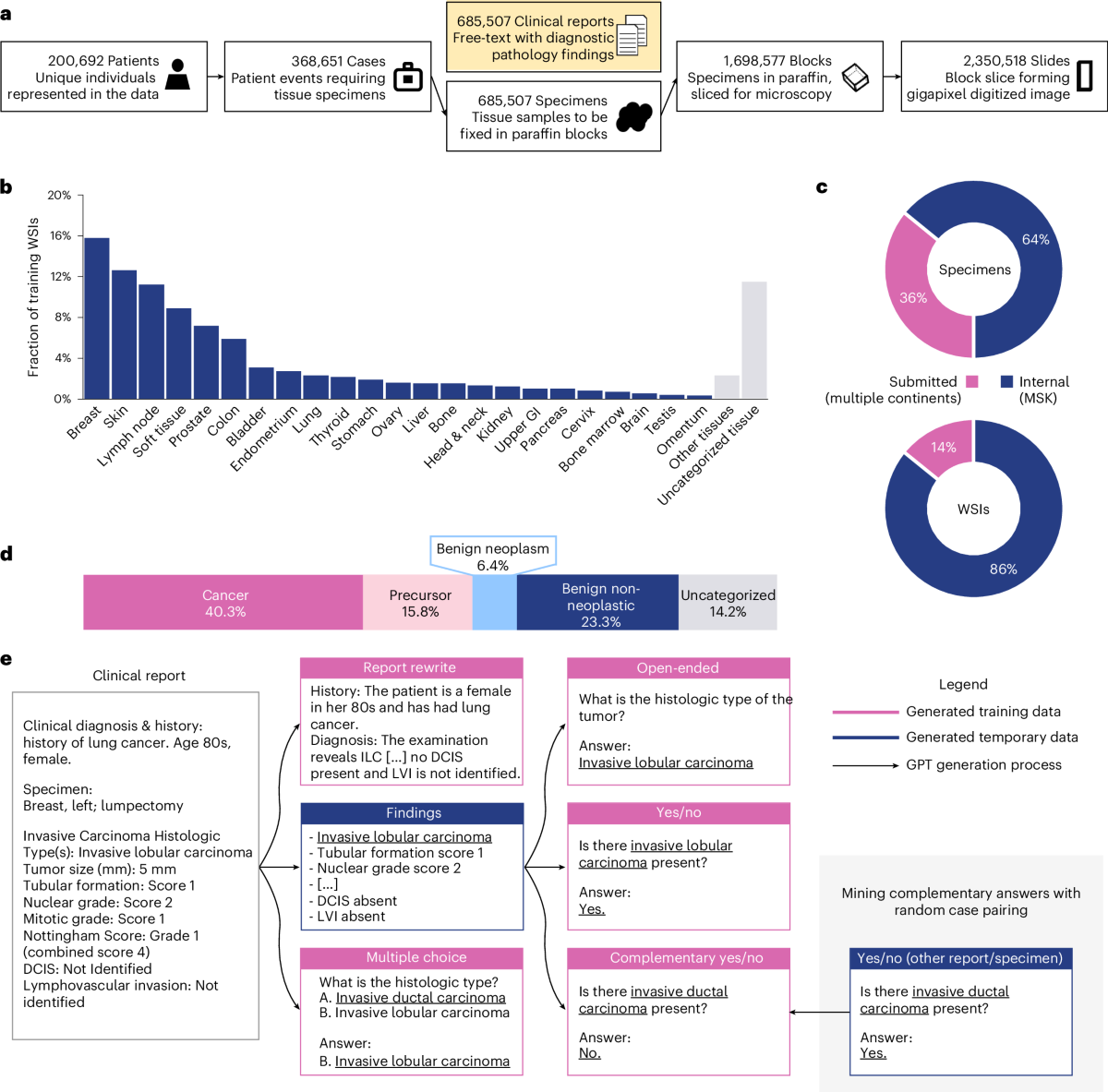
Routine reports are abundant, but they are inconsistent supervisory targets. Some follow structured templates, while others are free text; information density and reporting practices vary. The authors used GPT-4o and GPT-4.1 to transform each report into several training formats:
- a rewritten diagnostic report,
- yes/no questions,
- open-ended questions,
- multiple-choice questions based on College of American Pathologists (CAP) protocols, and
- image-report matching examples.
This process produced approximately 685,000 report rewrites and 14 million question-answer pairs. The key idea is that report generation alone asks the model to reproduce a long document, whereas targeted dialogue explicitly identifies the concepts that should be visible in the slide. Questions such as “Is ductal carcinoma in situ present?” or “What is the histologic type?” turn an unstructured report into many tractable supervisory signals.
PRISM2 combines two objectives. A contrastive loss brings the slide representation close to the paired diagnostic-summary representation, while an autoregressive loss teaches the language model to generate the appropriate answer:
\[\mathcal{L}_{total}=\lambda_{con}\mathcal{L}_{con}+\lambda_{chat}\mathcal{L}_{chat}.\]Training occurs in two stages. First, the slide encoder and image-text alignment components are trained while Phi-3 Mini remains frozen. Second, the slide encoder is frozen and the language model is fine-tuned on dialogue. This detail matters because continued diagnostic training can make a representation more specialized while making it less transferable.
One slide, two representations
PRISM2 exposes two different embeddings:
- The base embedding comes directly from the slide encoder. It retains broader morphological information and transfers better to outcomes that were not described in the dialogue data, such as biomarkers and survival.
- The diagnostic embedding comes from the hidden state of the language model after it has integrated the slide and prompt. It performs better on cancer detection, subtyping, grading, and other tasks closely aligned with pathology reports.
I found this separation especially important. A foundation model is often discussed as though one representation should be optimal for every task, but specialization has a cost. In the ablation study, longer diagnostic training improved diagnostic performance while weakening biomarker and survival transfer. Freezing the slide encoder early preserved the general base representation and allowed the language model to specialize separately.
The result is not simply two versions of the same embedding. It is an architectural acknowledgment that “generalizable” depends on the downstream question. The feature most useful for reproducing a diagnosis may not be the feature most useful for predicting a mutation or a long-term outcome.
Prompt-based inference is not the same as zero-shot inference
PRISM2 can answer a yes/no or multiple-choice question without training a new classifier. The paper calls this prompt-based inference, not zero-shot inference, because the diagnostic concepts being queried were already present during pretraining.
For a candidate answer \(c\), PRISM2 scores how much more likely the answer becomes after seeing the slide:
\[f(w_{<i},x)=\arg\max_{c \in C}\left[\log P(c\mid w_{<i},x)-\log P(c\mid w_{<i})\right].\]The second term subtracts the model’s text-only preference for an answer. This is important because a language model may prefer “yes” or a common diagnostic label even before seeing the tissue. The correction asks whether the image itself increased the probability of that answer.
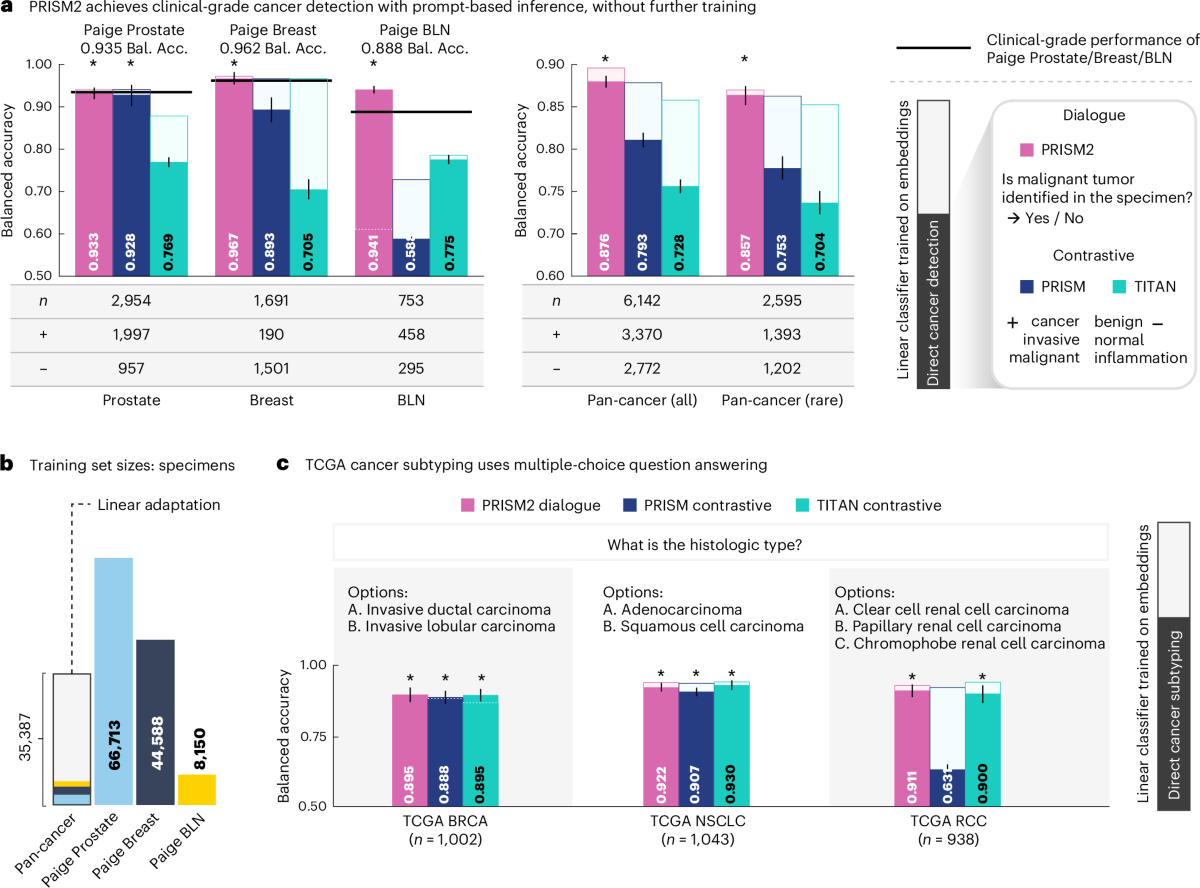
Using a fixed probability threshold of 0.5, PRISM2 achieved balanced accuracies of 0.933 for prostate, 0.967 for breast, and 0.941 for breast lymph-node cancer detection. These results matched the Paige Prostate and Breast systems and exceeded Paige BLN on their corresponding test datasets. PRISM and TITAN, two other slide-level vision-language models, performed worse using contrastive prompt classification.
This is a strong result, but the comparison needs context. The clinical products used carefully calibrated operating thresholds, whereas PRISM2 used a fixed threshold. On the other hand, all product benchmarks were internal datasets, the slides were scanned at MSK, and many authors were employees of the company that developed both PRISM2 and the comparison products. The evaluation patients were held out from PRISM2 and Virchow2 training, but this is not the same as prospective deployment in a new health system.
What transfers beyond diagnosis?
The paper evaluates far more than the three headline detection tasks. Linear probes were trained on PRISM2 embeddings for pan-cancer and rare-cancer detection, breast and gastrointestinal pathology, public TCGA subtyping datasets, lymph-node staging, prostate and colorectal grading, biomarker prediction, and survival.
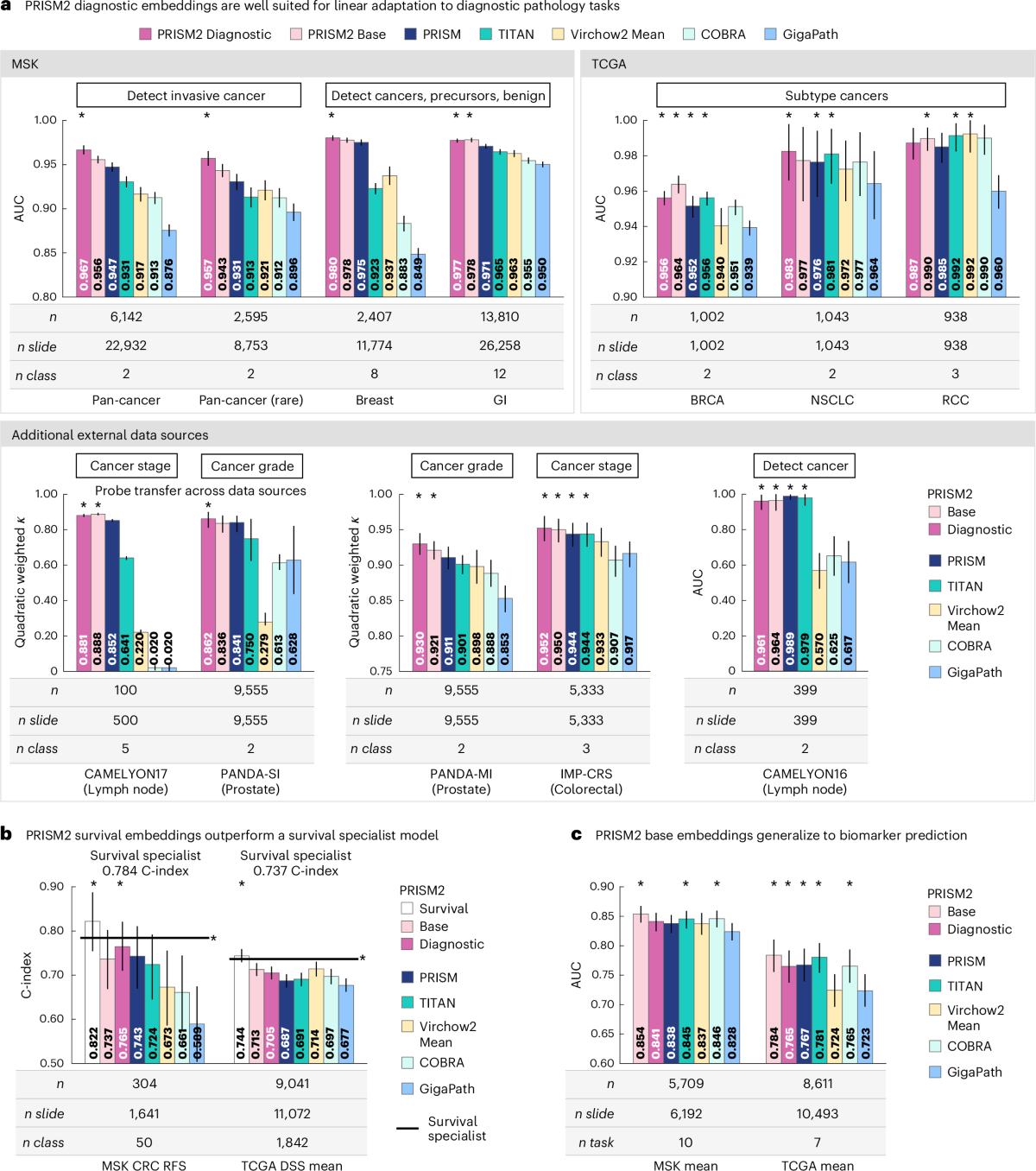
For pan-cancer detection, the diagnostic embedding reached an AUC of 0.967, compared with 0.956 for the base embedding, 0.947 for PRISM, and 0.931 for TITAN. The drop from common and rare cancers was small: the PRISM2 diagnostic embedding achieved 0.957 AUC on the rare-cancer subset.
The result that stood out to me was survival transfer. After pretraining, the authors fine-tuned the slide encoder using 225,597 cases with overall-survival information. On colorectal cancer recurrence-free survival, the resulting survival embedding achieved a C-index of 0.809, compared with 0.773 for the same architecture trained from scratch. This suggests that large-scale report-supervised pretraining can provide a useful starting point even when the downstream outcome was absent from the original dialogue.
Biomarker prediction was less dramatic. PRISM2 base embeddings had the highest mean AUC on the MSK and TCGA biomarker benchmarks, but the margins over the next-best models were small. Together, these experiments show both the potential and the boundary of clinical-language supervision: it strongly helps tasks that resemble diagnostic reports, while outcomes not routinely documented in those reports may still require explicit supervision.
Report completion reveals the calibration problem
PRISM2 also attempts to fill fields in a CAP breast-biopsy report through multiple-choice and yes/no questions. This is closer to a possible clinical workflow than a single benchmark label: a model could pre-populate a worksheet for pathologist review.
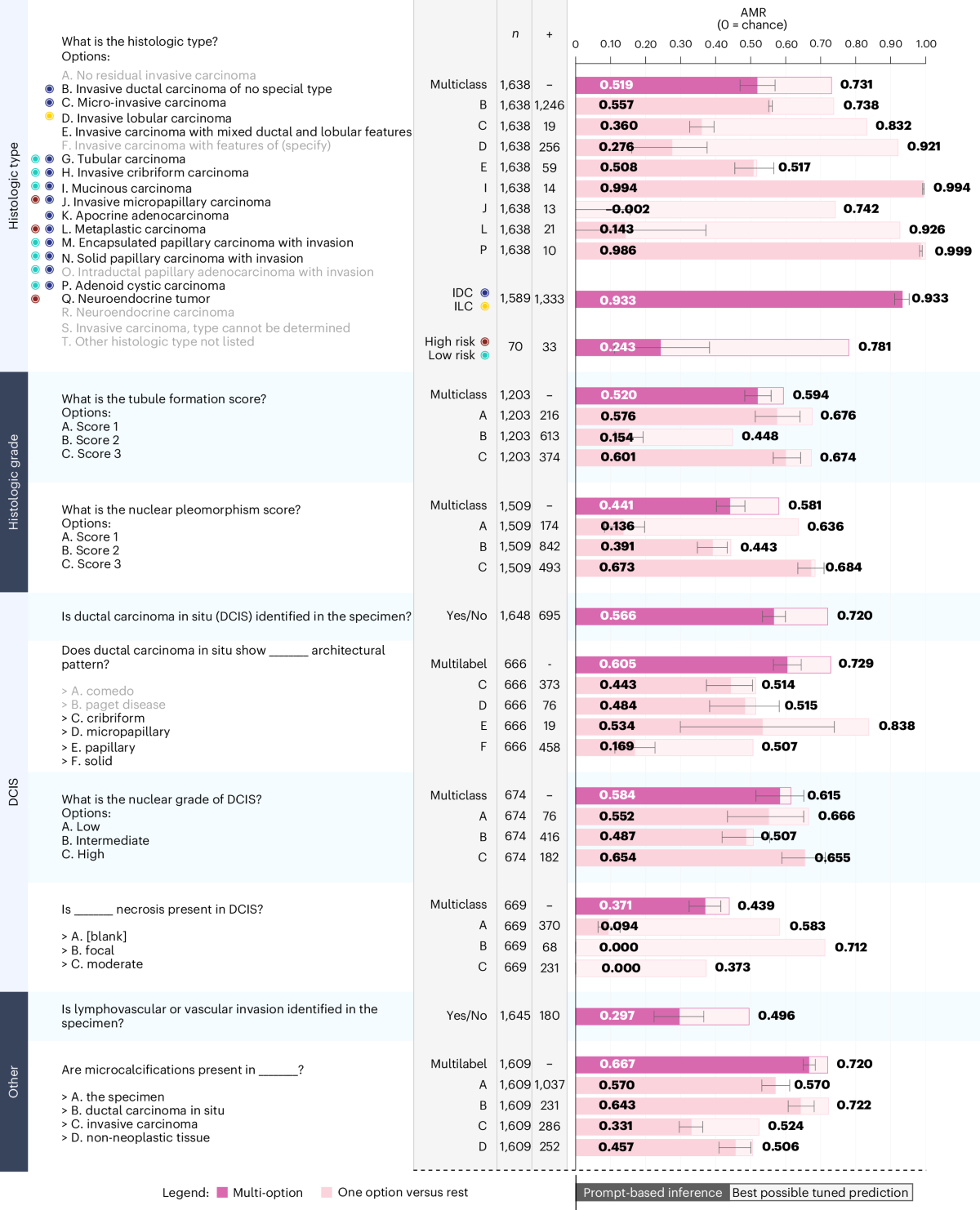
The model shows that it contains useful information, but its raw outputs are not uniformly reliable. Across the represented histologic types, adjusted mean recall increased from 0.519 to 0.731 after per-class calibration. For the common distinction between invasive ductal and invasive lobular carcinoma, performance was much stronger at 0.933 and did not benefit from calibration. Rare subtypes, lymphovascular invasion, and several DCIS fields were more difficult.
This gap is a useful reminder that discrimination and calibration are different. A model may rank cases correctly while still producing probabilities that cannot be used directly. In clinical practice, the threshold determines which cases are flagged, which fields are filled, and how many errors reach a pathologist. Calibration therefore is not a cosmetic postprocessing step.
The weakness hidden inside scalable supervision
The same reports that make PRISM2 scalable also carry clinical documentation biases. Positive findings are usually mentioned, while absent findings often are not. To create negative yes/no examples, the pipeline pairs a question from one report with another randomly selected specimen and assumes that an unmentioned finding is absent.
That assumption sometimes fails. In a pathologist review of 50 held-out specimens, the reference-data error rate was 3% for open-ended and multiple-choice questions, 8% for diagnostic summaries, and 18% for complementary yes/no questions. Errors included inaccurate ground truth, irrelevant questions, contradictions in the source report, findings copied from another specimen part, and questions requiring unavailable clinical context. The model itself made hallucinations, omissions, misclassifications, and logically inconsistent answers across prompts. Question-answering error rates were 7–11%, while full report generation was more error-prone.
This section connects closely to the missing-data problem. “Not mentioned” is not equivalent to “not present,” just as “not measured” is not equivalent to “normal.” Clinical reports reflect what a pathologist noticed, what a template requested, and what was relevant to that case. Scaling supervision from routine documentation is powerful, but it can also scale the documentation process’s blind spots.
Limitations
Several limitations affect how I interpret the results:
- The slide encoder has no positional encoding and uses one magnification. It can recognize local morphology but may not truly reason about global spatial relationships, lesion counts, or measurements.
- Training and internal evaluation slides were scanned at MSK on Leica scanners. Even externally submitted specimens were scanned and reported at MSK, so robustness to another laboratory’s staining, scanner, preparation, and reporting workflow remains uncertain.
- Much of the training data and several important evaluation datasets are proprietary. The authors released embeddings and dataset tables for reproducibility, but the underlying patient slides are available only through request.
- Prompt-based inference is not zero-shot learning, and matching a clinical-grade product on a retrospective product test set is not equivalent to clinical validation of PRISM2 as a general diagnostic system.
- Report completion was evaluated without a full analysis of inter-pathologist variability. This is especially important for subjective tasks such as grading and rare-subtype classification.
- The study evaluates prognosis but not treatment effects or counterfactual outcomes. A survival representation should not be interpreted as a model that can recommend an intervention.
Thoughts
PRISM2 is compelling because it uses language as more than an additional input modality. Clinical dialogue becomes a way to organize supervision: the model is taught not only that an image and report belong together, but also which diagnostic questions connect them. The ablation study supports this distinction—adding dialogue increased prompt-based balanced accuracy from approximately random performance (0.498) to 0.653 before the final scale-up.
For my own interests in cardiovascular prediction, the most transferable lesson is the separation between a general representation and a task-specialized one. The same idea could apply to ECGs, echocardiograms, cardiac imaging, and their paired clinical reports. A representation trained to reproduce an interpretation may excel at diagnosis, while a less specialized representation may retain information that is more useful for future risk or treatment response.
At the same time, PRISM2 reinforces a theme from my previous post on ICYM²I: routinely collected clinical data are shaped by workflow. Reports are not exhaustive descriptions of biology, and the presence or absence of a documented finding is not random. A model trained at this scale can learn rich clinical structure, but it can also learn what institutions choose to record, which cases receive expert review, and which findings templates make easy to express.
The paper therefore feels most useful as both a demonstration and a warning. Clinical language can turn millions of otherwise weakly labeled images into a powerful foundation model. However, the path from report-supervised pretraining to a trustworthy clinical system still requires external validation, calibration, careful analysis of label construction, and a clear definition of which representation should be used for which question.
Vorontsov, E., Shaikovski, G., Casson, A., et al. (2026). End-to-end multimodal pathology foundation model with clinical dialogue. Nature Medicine. Published July 31, 2026. https://doi.org/10.1038/s41591-026-04521-4 ↩


